Monday, October 28, 2013

Theater: That Hopey Changey Thing, Oct. 2013 at the Public Theater


A quiet and typical family scene opens:  preparations are being made for a family dinner in a liberal suburban town in New York state.

Newcomer Tim is introduced to a family of four adult siblings and their memory-challenged uncle Ben. 

Written and directed by Richard Nelson, there's just enough-of-everything present in the room to create an evening of surprise, drama, humor, and sharp daggers of politicized anger and - even - irrational hatred. Underscoring the dialogue is the premise that one of the siblings, Jane, is researching a book that she imagines might be useful as a societal autobiography: the manner and mores of common social situations revealing deeper beliefs and values by both "what is said" and "what is not said."

The playwright has cleverly focused the audience's attention on the unspoken

A brilliant piece of writing and beautifully acted.  -dp

From Joe Dziemianowicz's review in the New York Post: 
http://www.nydailynews.com/entertainment/music-arts/hopey-changey-wake-reviews-fine-tuned-ensembes-drive-political-plays-article-1.450088

Fine-tuned ensembles drive two politically charged plays at the Public Theater.
Richard Nelson's "That Hopey Changey Thing" begins with a dying cry of a dog, Oliver. The whimper echoes the sick feelings of everyone at the cozy Rhinebeck home of high-school English teacher Barbara Apple (Maryann Plunkett). 
She lives there with her ailing uncle Benjamin (Jon DeVries), a retired actor with amnesia brought on by a heart attack. Also on hand are Barbara's siblings -- Richard (Jay O. Sanders), a state lawyer, Marian (Laila Robins), a second-grade teacher, and Jane (J. Smith-Cameron), a writer who's brought her actor boyfriend Tim (Shuler Hensley).

It's Election Night 2010 (as in Tuesday) and this liberal Democratic clan expects a beating at the polls. Talk turns to "us" and "them," Cuomo, who's a shoo-in, and disenchantment with Obama. The mention of Sarah Palin (whose quote inspires the title) causes choking. Ditto when Richard reveals he has taken a job with the Republicans.

For timeliness, "Hopey Changey," presented as part of the Public's issue-oriented Lab series, has immediacy. But the election-night setting is just a convenience. What makes the play interesting is the detailed portrait that emerges of the all-American Apples -- a group with polish, bruises and maybe a even worm or two.

Nelson, who directs his play, evokes the Apples in conversation that sounds as natural as breathing. And the cast couldn't be better.

There's also a never-seen character, Toby, a new pooch for Benjamin to replace Oliver, who kept soiling the house in his dying days. Toby makes the same messes his predecessor did. In that way, he's like a lot of elected officials.


Read more: http://www.nydailynews.com/entertainment/music-arts/hopey-changey-wake-reviews-fine-tuned-ensembes-drive-political-plays-article-1.450088#ixzz2j1mF2I3E

Theater: Fun Home


From the review by Joe Dziemianowicz in the New York Daily News: http://www.nydailynews.com/entertainment/music-arts/fun-home-theater-review-article-1.1492941
The dearly departed were well cared for at the Bechdel funeral home in small-town Pennsylvania. 
“We remove all signs of trauma,” promises family-man proprietor Bruce Bechdel.
But the same can’t be said about the Bechdels themselves. 
The family shows several signs of trauma, especially the haunted Alison, who struggles with her past and the man who raised her.

So it goes in “Fun Home,” the achingly beautiful musical at the Public Theater. It speaks to one family and all families torn by secrets and lies.

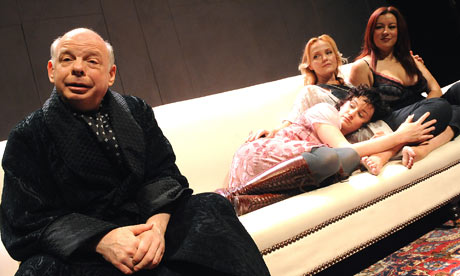
Theater: Wallace Shawn's "Grasses of a Thousand Colors" at the Public Theater, Oct. 2013


In this masterful epic play, Wallace Shawn takes us down the treacherous path of reasonableness. He's comfortable in his robe and slippers; he sees us, the audience, and welcomes us. Are we flattered when he tells us we look like a box of chocolates, ready to be eaten and enjoyed? Yes! Are we sympathetic with his ambitions as a scientist to solve the greatest problem of humankind: insufficient food? Yes! Are we entertained by stories of sexual prowess and sexual adventure? No surprise: Yes!

Written by Wallace Shawn and directed by Andre Gregory, the play unfolds as a futuristic vision of the accidental destruction of the world.  The lead character, Ben, has invented an improvement to the food chain. As audience, we experience the anguish of self-destruction while entertained by Ben's life story in which overt and outlandish sexual behavior is a symptom of the new illness he has imposed on humankind.  Is this a mirror of our "reasonable" present-day lives? Frighteningly I must answer, yes.  -dp

More from critic John Lahr's 2009 review in the New Yorker Magazine:
http://www.newyorker.com/arts/critics/theatre/2009/06/01/090601crth_theatre_lahr
At the beginning of the three-hour “Grasses of a Thousand Colors” (superbly directed by André Gregory), Shawn is at it again: he stands before us as Ben, a scientist and a memoirist, in a black dressing gown, black monogrammed slippers, and black cravat, and plays his familiar wrong-footing game of self-deprecation. He is dressed as an agent of darkness, but he is bright with good will. “Well. Hello, everybody. Hello! Hello there!” he says, in his lisping, halting, high-pitched voice. He goes on, “When you’re all so nicely sitting there and listening to me, I’m deriving a great deal of pleasure from each and every one of you, as if you were chocolates I was eating.” In this futuristic dream play, eating and being eaten are important leitmotifs. Ben, we learn, is one of the barbarians who have devoured the planet, and, beneath his charm, he is as unrepentant as a hedge-fund manager. “Loaves, with Fishes, for Dinner” is the title of the memoir from which he reads to us, and which hints at his majestic self-infatuation.
Ben is perhaps the most unreliable of Shawn’s many unreliable narrators. His smugness—“I was born lucky”—is rivalled only by the imperialism of his convictions. “We’re fixers, improvers,” he says of his optimistic generation. The thing that he has fixed, it turns out, is the “problem of food.” As he pompously puts it, “There was, on the one hand, an enormous crowd of entities—ourselves and others—roaming the planet, trying to sustain themselves, or, in other words, looking for something to eat; and on the other hand there was a tiny, inadequate crowd of entities available on the planet to be eaten.” The appliance of Ben’s science allows the animal kingdom—frogs, cows, his own dog, Rufus, and, by implication, Homo sapiens—to feed on its own kind, as well as on the corpses of other animals. The discovery has made him rich; it has also destroyed the food chain. Things have gone disastrously wrong: animals are dying, and people are vomiting and keeling over.  (jump to link to read complete review)

Thursday, October 17, 2013

Thurs. Oct. 17th: Esteli Gomez, soprano, and Colin Davin, guitar


An evening of songs for soprano voice and guitar entitled "Ancient Melodies, Modern Echoes" was presented at the Holy Trinity Lutheran Church at 65th St. and Central Park West.

The program was split 3-ways between composer Benjamin Britten (1913-1976) ("perhaps the greatest 20th century composer of art songs"), Renaissance composer John Dowland (1563-1626), and a single piece by contemporary composer Caroline Shaw.

Of Dowland's songs, I loved the ancient poetry written in the time of Queen Elizabeth and Shakespeare. This excerpt from Come Again:

Come again, Sweet love doth now invite, Thy graces that refrain, To do me due delight,  To see, to hear, to touch, to kiss, to die, With thee again in sweetest sympathy. 
Come again, That I may cease to mourn, Through thy unkind disdain: For now left and forlorn I sit, I sigh, I weep, I faint, I die, In deadly pain and endless misery.
All the day, The sun that lends me shine, By frowns do cause me pine, And feeds me with delay, Her smiles my springs, that makes my joys to grow, Her frowns the Winters of my woe.  (and poem continues...)

Of Britten's many songs, it was a special treat to follow along through the sections of Nocturnal after John Dowland, op. 70 for solo guitar and, in the last part, soprano voice:

i.      Musingly  
ii.     Very Agitated 
iii.    Restless 
iv.    Uneasy 
v.     March-Like 
vi.    Dreaming 
vii.   Gently Rocking 
viii.  Passacaglia 
ix.    Slow and Quiet ("Come, heavy Sleep")
It was a marvelous performance in the lovely and colorful setting of the church. It was extra special to be there with son Elliot.

Tues. Oct. 14th: The Gotham Jazzmen (free weekly noon concert)


Piano. Upright bass. Clarinet. Cornet. Drums. Trombone.

The professional pedigrees of the Gotham Jazzmen, as they like to be known when they are performing at the New York Public Library of the Performing Arts (Lincoln Center, UWS), would combine to be a couple of hundred years of music education and performance.

They gave us a rich, nuanced experience of New Orlean's-type jazz.  Some hits from their set list (from my notes, might be slightly wrong titles!):

  • Bye Bye Blackbird
  • Everybody Loves My Baby
  • How Deep is the Ocean
  • Crazy Rhythm
  • Creole Love Song
  • Christopher Columbus
  • Willow Weep for Me
  • Me, Myself and I

I can't wait to become a regular at their Tuesday noon concerts.  Three of them have another band called The Creole Cookin' Jazz Band, which is performing on Sunday nights from 7-10 pm at Arthur's Tavern in Greenwich Village, NYC.  http://www.arthurstavernnyc.com/performances.html

Sunday Oct. 13th: "The Forty Part Motet" in the Fuentidueña Chapel, the Cloisters, NYC

The Cloisters Museum, part of the Metropolitan Museum of Art in NYC, hosted this exhilarating soundscape performed by 40 speakers set up in an oval inside a 12th century chapel.
"The Forty Part Motet (2001), a sound installation by Janet Cardiff (Canadian, born 1957), will be the first presentation of contemporary art at The Cloisters."
It made me wonder what it would be like to be a choir member able to perform an exquisite piece of complex music. By walking the perimeter, as the first video below demonstrates, the listener is able to focus on individual voices, one at a time. I was thrilled to practically hear a new piece of music come to life at various speakers, experiencing each chorister's personal soundscape, as I walked the perimeter.

The Cloisters describes this as an installation of contemporary art - the first one ever - at the museum. Perhaps they could make this a permanent exhibition? It would be an awesome addition.

From YouTube, a good example of the soundscape (although in a different architectural setting):


 More about the project, as performed in another location:

Monday, September 9, 2013

"The Recommendation" by Jonathan Caren at the Flea Theater 9/7/13

The Recommendation is a fine play energetically performed by The Bats of the Flea Theater. The storyline: college student Feldman is generous with his offerings of social advancement strategies to his hapless roommate Izzy. These include "recommendations" by his influential family to aid Izzy to be admitted to graduate school and later offered a prestigious job.

We learn that Feldman also has a dark secret; Izzy remains innocent of the fact. When Feldman finally asks for a favor, can Izzy refuse?  -dp


(Online information source: http://www.theflea.org/show_detail.php?page_type=0&page_id=1&show_id=138)

"Aaron Feldman is popular and connected. He is everything his best friend Iskinder Iudoku is not, but when Feldman gets pulled over for a broken taillight, he is introduced to a world where privilege means nothing and Iskinder has the advantage. A play about friendship, class and where loyalty has its limits.

The 2012 production at The Old Globe in San Diego won the Craig Noel Outstanding New Play Award."

Featuring The Bats:
Barron Bass, James Fouhey, Alex J. Gould, Donaldo Prescod, Orlando Rivera, and Austin Trow.
Written by Jonathan Caren
Directed by Kel Haney
Set Design Caite Hevner Kemp
Lighting Design Nick Solyom
Costume Design Sydney Maresca
Sound Design Elisheba Ittoop
Fight Director Mark Olsen

Saturday, June 15, 2013

Film: Twenty Feet from Stardom


Movie Info

Millions know their voices, but no one knows their names. In his compelling new film 20 FEET FROM STARDOM, award-winning director Morgan Neville shines a spotlight on the untold true story of the backup singers behind some of the greatest musical legends of the 21st century. Triumphant and heartbreaking in equal measure, the film is both a tribute to the unsung voices who brought shape and style to popular music and a reflection on the conflicts, sacrifices and rewards of a career spentharmonizing with others. These gifted artists span a range of styles, genres and eras of popular music, but each has a uniquely fascinating and personal story to share of life spent in the shadows of superstardom. Along with rare archival footage and a peerless soundtrack, 20 FEET FROM STARDOM boasts intimate interviews with Bruce Springsteen, Stevie Wonder, Mick Jagger and Sting to name just a few. However, these world-famous figures take a backseat to the diverse array of backup singers whose lives and stories take center stage in the film. (c) TWC-Radius

http://twentyfeetfromstardom.com/synopsis

Friday, June 14, 2013

Film: You Ain't Seen Nothin' Yet


Found online: http://www.kinolorber.com/film.php?id=1346

Release Year: 2012
Running Time: 115
Color Type: Color
Country: France, Germany
Language: French w/English subtitles

Based on two works by the playwright Jean Anouilh,You Ain't Seen Nothin' Yet opens with a who's-who of French acting royalty (including Mathieu Amalric, Michel Piccoli and frequent Resnais muse Sabine Azema) being summoned to the reading of a late playwright's last will and testament. There, the playwright (Denis Podalydes) appears on a TV screen from beyond the grave and asks his erstwhile collaborators to evaluate a recording of an experimental theater company performing his Eurydice--a play they themselves all appeared in over the years. But as the video unspools, instead of watching passively, these seasoned thespians begin acting out the text alongside their youthful avatars, looking back into the past rather like mythic Orpheus himself. Gorgeously shot by cinematographer Eric Gautier on stylized sets that recall the French poetic realism of the 1930s, You Ain't Seen Nothin' Yet is an alternately wry and wistful valentine to actors and the art of performance from a director long fascinated by the intersection of life, theater and cinema.


Thursday, June 13, 2013

Film: Image from The Flavor of Green Tea Over Rice

Film: THE FLAVOR OF GREEN TEA OVER RICE

From the Film Forum website:
"(1952) At first glance, Shin Saburi seems the thick-headed dullard wife Michiyo Kogure likens to a carp, while she seems a spoiled snob, but then the layers of character peel away, as Keiko Tsushima (7 Samurai) flees from an arranged marriage and eventual yakuzalegend Koji Tsuruta extols buying second-hand. And a resolution seems inevitable at the simple plain meal of the title. Approx. 115 min. 35mm."

Saturday, June 8, 2013

Film: The Discovery at Dawn

From the website:  http://www.filmlinc.com/films/on-sale/the-discovery-at-dawn

Kent and I were swept away by this film today at Lincoln Center.  Exiting the theater, we glanced into the nearby cafe and saw director Susanna Nicchiarelli sitting at a nearby table. We spoke to her and told her how much we enjoyed the film; she stood up and smiled; we had a sweet private conversation with her for a minute or two. We were so excited to be able to share with her our appreciation of her brilliant and engaging film!


THE DISCOVERY AT DAWN
LA SCOPERTA DELL'ALBA | SUSANNA NICCHIARELLI, 2012
ITALY | ITALIAN WITH ENGLISH SUBTITLES | 95 MINUTES

"Rome, 1981:  Professor Mario Tessandori is shot in the university courtyard and dies in the arms of Lucio Astengo, his friend and colleague. A few weeks later, Astengo vanishes mysteriously.  Flash forward to 2011. Caterina and Barbara Astengo, six and 12 when their father passed away, put up for sale their family cottage by the sea, which has long since been abandoned. The house is filled with memories of a childhood interrupted by the father's disappearance, a broken family that never reassembled. In one corner, there's an old phone still attached to the outlet. Caterina picks it up and discovers that, inexplicably, it works, even though the line is disconnected. Playfully, she dials her home number from 30 years earlier and hears the voice of a child responding on the other end. In shock, she realizes that she is speaking to her 12-year-old self, a week before the death of her father. She's been given a second chance, if not to save him then at least to uncover the truth. Wonderful performances by Margarita Buy and Nicchiarelli herself as Caterina's sister."

Monday, May 27, 2013

Dance: Polina Semionova with American Ballet Theater in Don Quixote, May 27, 2013

Found online:

"Based on Miguel de Cervantes' sweeping tale of romance and chivalry, the knight-errant of la Mancha, Don Quixote, and his devoted squire, Sancho Panza, are positively heroic when it comes to aiding the spirited maiden Kitri and her charming amour. From the bravura dancing of the fiery toreador Espada to the colorful caravan of gypsies, the stage explodes with one show-stopping performance after another in this feast of choreographic fireworks."

Here is a review from the New York Times of her performance in 2011.


Thursday, May 23, 2013

Plimpton's NYC apartment - party

Film: Plimpton! Starring George Plimpton as Himself

Found online:
"Witty, sophisticated, urbane and yet a man of the people, [George Plimpton] embodied the American optimism of 1960s and '70s. He co-founded and edited one of the most influential literary magazines in history, The Paris Review for 50 years, and in the process, he innovated a writing technique called participatory journalism. This gave Plimpton a unique perspective on the activities he wrote about, perhaps most famously with Paper Lion, a bestseller, which has never left the conversation of the greatest sports books of all-time."

http://www.filmlinc.com/films/on-sale/plimpton-starring-george-plimpton-as-himself

Sunday, May 19, 2013

Dance: Rennie Harris Awe-inspiring Works (RHAW)

Consider me a big fan, officially, as of right now.

Rennie Harris is a living master and the performance today by his pre-professional dance company was beyond words; okay - throw at it "beautiful, exhilarating, amazing." "Awe-inspiring" is correct.  Dr. Harris (with an honorary Doctorate in Fine Arts from Bates College) has a professional pedigree that includes the Alvin Ailey Award for Choreography, three Bessie Awards and a 2010 Guggenheim Fellowship. His professional company is called "Rennie Harris Puremovement" - but today's RHAW dancers at the New Victory Theater (NYC, 5/19/13) already made the grade. I had to take a big breath at intermission to keep from crying. It was that good.

Here's the review in the New York Times.

It was especially interesting to see this hip-hop performance after recently seeing "The Spectators" by Pam Tanowitz (http://www.nytimes.com/2013/05/17/arts/dance/the-spectators-at-new-york-live-arts.html?_r=0). If you had an itemized list of features to compare the two dance programs, the RHAW hip hoppers would still be top dog for:  inventiveness, energy, formal choreographic structures, emotional connection, profound physical training and sheer joy. In addition, even though the RHAW music choices tended to be obvious, it at least helps to develop in dancers that extra bit of magic: musicality. No matter how diligently Ms. Tamowitz chips away at the ballet vocabulary, the only emotional response I heard in the audience around me was a chuckle of recognition when one dancer, with curved modern-dance spine, beat her balletic legs together. Compare this to Mr. Harris' work where the audience gasps unexpectedly again and again - and for the subtler reasons as well as the smashing big ones.


  http://www.rennieharrisrhaw.org

Wednesday, May 15, 2013

Film at MoMA: Old Dog

Kent called it "a sketch of a poem."  In Tibet: a childless couple, an old man and his dog, a policeman and a school teacher; in a setting of new town construction, grassland hills, ruins of lost villages, a pastoral simple shepherd's home; populated by sheep, goats, pigs, motorcycles, ponies, trucks and cars. A pool table is set up and played in a muddy street. An infomercial on TV shamelessly tries to sell gold jewelry to people who can barely get signal reception. What will become of the old dog?


Found online:


Old Dog

2011. China. Directed by Pema Tseden. With Yanbum Gyal, Droluma Kyab, Lochey. A young Tibetan decides to sell his family's nomad mastiff, an exotic dog that fetches a fortune from wealthy Chinese. His aging father opposes him, leading to a series of tragicomic events that threaten to tear the family apart. Pema Tseden is the leading filmmaker of a newly emerging Tibetan cinema, and the first director in China to film his movies entirely in the Tibetan language. His third feature, Old Dog employs an observational documentary approach that soberly depicts the erosion of Tibetan culture under the pressures of contemporary society. Courtesy of dGenerate/Icarus. 88 min.


http://www.moma.org/visit/calendar/film_screenings/18237

Monday, May 13, 2013

Film: In the House

Found online:

Anthony Lane: "In the House" Review : The New Yorker, APRIL 29, 2013

"It seems not just against the odds but against the laws of nature that a film as bookish, as suburban, and as self-consciously clever as "In the House" should also be such fun. To make things even more unlikely, it's about a teacher, and the nearest it comes to an action sequence is when someone photocopies a math test. There is sex, of course, this being a French movie, but it's extremely brief, and, most outrageous of all, it occurs between two people who are married to each other. What, then, is the appeal?

Our unheroic hero is Germain (Fabrice Luchini), who teaches literature at the Lycée Gustave Flaubert—a first hint that the application of style, at whatever cost, will lurk at the movie's heart. Germain is married, childlessly, to Jeanne (Kristin Scott Thomas), who runs an art gallery. We sense an easy rapport between them; she doesn't object when he reads Freud's "Civilization and Its Discontents" in bed, and she enjoys listening when he comes home and reads out his pupils' essays to her, the better to grumble about the narrowness of their minds. But wait.

One essay is by a boy named Claude (Ernst Umhauer), who recounts that he went to see Rapha (Bastien Ughetto), a fellow-pupil, ostensibly to help with math homework. As Claude admits, however, he used to stand in the park opposite Rapha's place, the previous summer, and watch; now, "at 11 a.m., I rang the bell, and the house finally opened up to me." As Germain reads out these words, he pauses, and glances up at Jeanne. Imperceptibly, with excitable stealth, the camera starts to move, approaching each of them in turn. They, like us—like every listener since the Sultan who summoned Scheherazade—are being lured into the spinning of a yarn. The process is both ominous and funny, all the more so because we gather, from sticky experience, that the yarn will turn out to be a web.

Claude has more to report. He mentions "the singular scent of a middle-class woman," which emanates from Rapha's mother, Esther (Emmanuelle Seigner). One sniff is enough. Henceforth, in pursuit of her, Claude will return repeatedly to the scene of the crime—or, at least, of his voyeuristic sins—and try to transcribe, in a series of essays, both his exploits and the flux of his feelings. On the strength of these, Germain starts to coach him after hours, at school, arguing that Claude, as a type of proto-novelist, ought to refine his powers of description. The kid is told to write more coolly, then with more passion; like Flaubert, like Dostoevsky, and so on. We find ourselves, in other words, in a late-flowering offshoot of one of the great modernist ambitions, which reached full bloom in "Ulysses": the urge to try out every conceivable style, not as a show of skill but in a bid to grasp a world so rich and multifarious that it threatens, or rejoices, to elude our clutches. Truth is stranger than diction.

All of which makes "In the House" sound less like a movie and more like a novel itself. In fact, it is directed by François Ozon, who has ranged prolifically from bright pastiche, in "8 Women" and "Potiche," to grave studies of grief and desire, like "Under the Sand" and "Time to Leave." He has flirted with literary artifice before, in "Angel," but the result rang strangely and determinedly false. In the new film, though, his tuning is exact, his actors miss not a trick, and, without our really noticing, his story dances along at a rattling rate. Ozon, like Pedro Almodóvar, is too wise to look down on melodrama, and some of Claude's incursions into Rapha's family are pricked with unabashed suspense—helped by the shyly smiling Umhauer, whose performance as Claude lies within stroking distance of devilry, with the cheekbones to match.

Luchini makes the ideal foil, for, as Germain, he clings to the softest of delusions—the idea that, if you've read enough books, you are cushioned against the shocks of body and soul, and are obviously too astute to wind up as a dupe. Eyes widening behind his glasses, he digs himself irretrievably deep into the fates of the other characters, and lets go of his own. The most urgent debt here is to "Céline and Julie Go Boating," the Jacques Rivette film in which two young women keep entering a house of mystery and staggering out again, a while later, as if high on pure narrative. As for Ozon's final image, it nods in glowing tribute to "Rear Window." The house of fiction, as Henry James said, has many windows, front as well as rear, and "In the House" stares through just one of them, at a minor crisis in the life of the bourgeoisie. Yet the view it affords is at once so silvery-clear and so misted with longing and confusion that, unexpectedly, it draws us close to heartache. Germain is a hero of sorts, by the end, because he has the courage to lose everything to our unhealable human sickness: the need to know. "

http://www.newyorker.com/arts/critics/cinema/2013/04/29/130429crci_cinema_lane?mobify=0

Sunday, May 12, 2013

Theater: The Caucasian Chalk Circle, 5/11/13

From the web: http://www.classicstage.org/season/chalkcircle/

By BERTOLT BRECHT
New Music by DUNCAN SHEIK
Directed by BRIAN KULICK
"Terrible is the temptation to do good!" warns Bertolt Brecht's amiable narrator. But good is all that Grusha, the simple kitchen maid, knows. And so, in the midst of a revolution, she cannot help but come to the aid of a poor defenseless infant. Their subsequent misadventures across her war-torn country become the heart of Brecht's playful parable, which calls into question our basic assumptions of right in a world that has gone wrong. This production boasts a new score and new songs by acclaimed singer/songwriter Duncan Sheik and is helmed by CSC Artistic Director Brian Kulick, who directed last season's sold-out production of Brecht's GALILEO.
 Cast
JASON BABINSKY, ELIZABETH A. DAVIS, TOM RIIS FARRELL, ALEX HURT, CHRISTOPHER LLOYD, DEB RADLOFF, MARY TESTA
Scenic Design TONY STRAIGES
Costume Design ANITA YAVICH
Lighting Design JUSTIN TOWNSEND
Sound Design MATT KRAUS

Tuesday, May 7, 2013

Music: Violinist Benjamin Beilman, Merkin Hall, May 7, 2013


Music:  Violinist Benjamin Beilman, Merkin Hall, May 7, 2013

Artists: Yekwon Sunwoo (Piano); Benjamin Beilman (Violin)

Poulenc: Sonata for Violin and Piano
Brahms: Sonata for Violin and Piano no 2 in A major, Op. 100
Messiaen: Fantasie for Violin and Piano
Schubert: Fantasy for Violin and Piano in C major, D 934/Op. posth. 159